Creeper Keyword Density Checker Tool
Welcome to our free online keyword density checker tool!
Looking to enhance your website's SEO performance by optimizing the keyword density on your web pages? Look no further. Our user-friendly tool allows you to analyze the frequency of your chosen keywords on any URL while considering stopwords in English, Spanish, Slovene, and Croatian.
Filter Columns
No. of Results
| Word/Phrase | Occurrences | Frequency (%) | Number of Words |
|---|
Filter Columns
No. of Results
| Word/Phrase | Occurrences | Frequency (%) | Number of Words |
|---|
Filter Columns
No. of Results
| 1 Word | # | Freq | KW? | 2 Words | # | Freq | KW? | 3 Words | # | Freq | KW? | 4 Words | # | Freq | KW? | 5 Words | # | Freq | KW? |
|---|
The Complete Guide to Creeper Keyword Density Checker Tool
Keyword density remains a fundamental aspect of on-page SEO, though its role has evolved significantly. Our Creeper Keyword Density Checker Tool goes beyond simple frequency counting - it analyzes live URLs, supports multi-keyword analysis, and generates comprehensive n-gram reports up to 5 words.
This guide explains what keyword density means in modern SEO, how to use our tool strategically for content optimization and competitor benchmarking, and how to balance keyword usage with user experience. We'll also explore how density fits alongside stronger ranking signals like backlinks and domain authority.
Unlocking SEO Potential: Your Guide to the Creeper's Free Keyword Density Checker Tool
In digital marketing, where visibility is key, optimizing your content for improving search engine rankings of your website is a priority. We proudly present our Creeper's Free Keyword Density Checker Tool, a simple, yet powerful tool that will boost your search engine optimization efforts and help inform your keyword research, increase content relevance, and avoid unnecessary repetition.
What is Keyword Density?
Keyword density is the percentage of times a target keyword appears compared to total words. The formula is simple:
Keyword Density (%) = (Number of times keyword appears / Total words) × 100
For example, if "organic gardening tips" appears 7 times in a 500-word post: (7 / 500) × 100 = 1.4%

Keyword Density in Modern SEO: A Supporting Factor
Here's the truth: keyword density alone won't make or break your rankings. Modern algorithms like Google's RankBrain and BERT focus on understanding user intent, semantic relationships, and content quality. However, density still helps search engines identify your content's primary topic, ensures you're not neglecting target keywords, and acts as a guardrail against both stuffing and under-optimization.

The Role of Backlinks and Domain Authority as Stronger Ranking Signals
While checking keyword density is valuable for on-page optimization, understand the hierarchy of ranking factors. Backlinks from authoritative websites remain one of the strongest signals. Domain authority, keyword difficulty, content depth, and user engagement metrics increasingly influence rankings more than perfect density. A perfectly optimized page with 1-2% density will struggle to rank without quality backlinks and against high-authority domains. View keyword density as one component of a holistic SEO strategy, not a silver bullet.

Optimizing for Users, Not Just Algorithms
The most important principle: write for humans first, optimize for search engines second. Modern algorithms reward content that answers questions thoroughly, maintains natural readability, and uses varied vocabulary instead of repetitive keywords. Use density insights to enhance readability rather than chase arbitrary percentage targets.

Why Use A Keyword Density Checker?
This simple keyword density test will inform your SEO strategy for individual pages by telling you whether using synonyms in several instances would help you avoid being penalized by Google, Bing, and/or other search engines and their algorithms for using illegal practices like keywords stuffing or web spam.
It will also enable you to better target website content to match relevant search queries. If you wish to check your whole site or domain for problems related to title and meta description tags, backlinks, image alt texts, indexing, or other technical SEO-related issues, use the free (or paid) version of our website crawler - Creeper SEO Audit Tool - that you can read more about here.
Let's explore its features and capabilities, focusing on how our density calculator addresses various aspects of keyword analysis and density, all while being a free tool.
Avoiding Both Over-Optimization and Under-Optimization
The sweet spot sits between two extremes. Over-optimization (keyword stuffing) typically occurs above 5-6% density, creating unnatural reading and potential penalties. Under-optimization (below 1%) may signal weak topical focus.
Compare these examples:
Keyword Stuffed: "Our organic gardening tips include the best organic gardening tips for beginners. These organic gardening tips will help you master organic gardening."
Natural and Optimized: "Our comprehensive guide to organic gardening includes practical tips for beginners. You'll learn essential techniques for soil preparation, natural pest control, and sustainable growing practices."

Using Density for Competitive SERP Analysis
One of the most valuable applications is competitive benchmarking. Analyze the top 10 ranking pages for your target keyword to identify patterns. Search your target keyword, use the Creeper tool on each ranking URL, note the density range, and look for the median density. This reveals what's actually working in your niche rather than following generic recommendations. Tools like Semrush can complement this by providing additional keyword choice insights and statistics on search volume.

Understanding Density Within Modern SEO: NLP, Entities, and Semantic Relevance
Today's search algorithms don't just count keywords—they understand language. Google's NLP technology analyzes semantic relationships, identifies entities, understands context, and recognizes topical clusters. Use your target keyword strategically in key locations while incorporating natural variations, synonyms, and related concepts throughout your content.

The Reality Check: Density Alone Won't Help You Rank
You cannot rank through keyword density optimization alone. Keyword difficulty measures how hard it is to rank based on the authority of currently ranking pages. A keyword with high difficulty requires dozens or hundreds of quality backlinks regardless of your density.
Use the Creeper Keyword Density Checker as one tool in your toolkit, but invest equal effort in building quality backlinks, creating comprehensive content, and improving user experience. For technical SEO improvements, consider our Creeper SEO Audit Tool, and for page speed optimization, explore our Creeper CWV RUM Tool.

Manual Calculation Example: Understanding the Numbers
To better understand keyword density, let's walk through a manual calculation. Imagine you've written a 1,000-word article about "content marketing strategy" and you want to check if your keyword usage is appropriate.
Step 1: Count total words in your content = 1,000 words
Step 2: Count how many times "content marketing strategy" appears = 12 times
Step 3: Apply the formula: (12 / 1,000) × 100 = 1.2%
A 1.2% density for your primary keyword is generally in a healthy range. Now, what if you also used variations?
- "content marketing strategy" appears 12 times (1.2%)
- "content strategy" appears 8 times (0.8%)
- "marketing tactics" appears 5 times (0.5%)
Your total focus on the core topic (combining the main keyword and close variations) is 2.5%, which indicates strong topical focus without over-optimization. This is exactly the kind of insight our tool provides automatically, saving you from tedious manual counting.

Key Features and Capabilities
The Creeper Keyword Density Checker offers comprehensive features beyond basic density calculators, including multi-keyword tracking, automated n-gram generation, frequency filtering, multilingual stopword support, and exportable reports.
Live Keyword Frequency Analysis
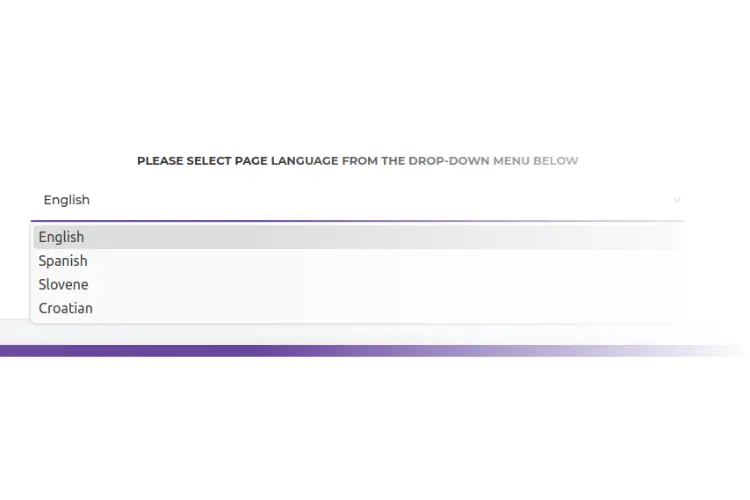
Analyze any live URL in real-time by entering the webpage address, specifying target keywords (one per line), and selecting your language. The tool automatically generates n-grams from 1-word phrases up to 5-word phrases. For each keyword and n-gram, you'll see exact occurrence counts and calculated density percentages.
Multilingual Stopword Support
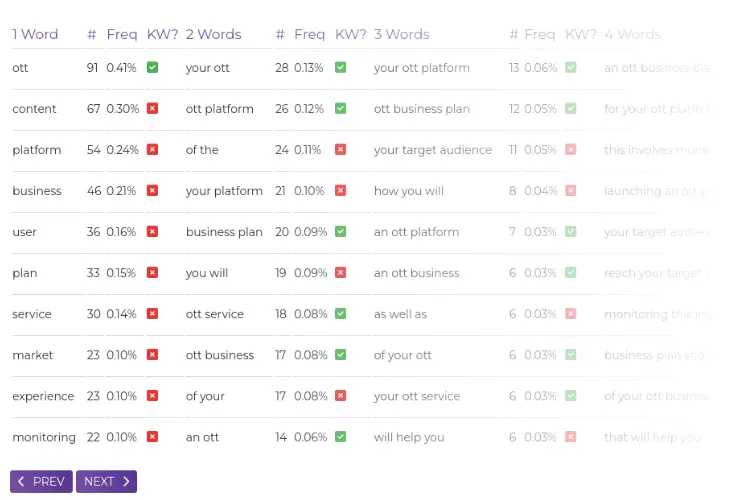
Our tool provides intelligent stopword filtering in English, Spanish, Slovenian, and Croatian. Simply select your preferred language from the checkbox options in the tool interface. This ensures density calculations focus on meaningful keywords rather than common words like "the," "and," or "is," giving you accurate, language-appropriate analysis for international SEO campaigns.
User-Friendly Interface
The intuitive design makes sophisticated keyword analysis accessible to all skill levels. The tool interface is conveniently located right on this page, allowing you to start analyzing immediately without any registration. Simply:
- Enter your URL in the webpage address field
- Add your target keywords (one per line for multiple keywords)
- Select your language from the checkbox options (English, Spanish, Slovenian, or Croatian)
- Click "Analyze" to generate your comprehensive density report
- Export results instantly to Google Sheets with a single click
Results appear in clear, organized tables you can quickly scan to identify patterns. No complicated setup, no learning curve—just instant, actionable insights.
Filtering
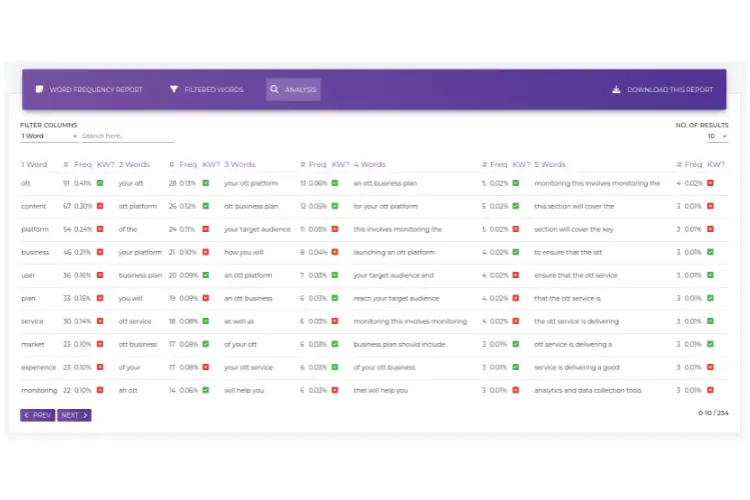
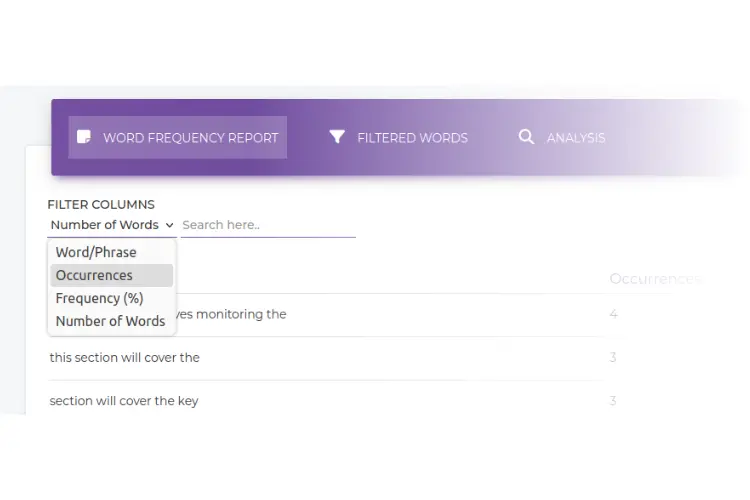
Set minimum frequency filters to show only keywords appearing a certain number of times, focusing on the most significant patterns. Filter by n-gram type to isolate specific phrase lengths (1-word, 2-word, up to 5-word phrases).
Export the Results
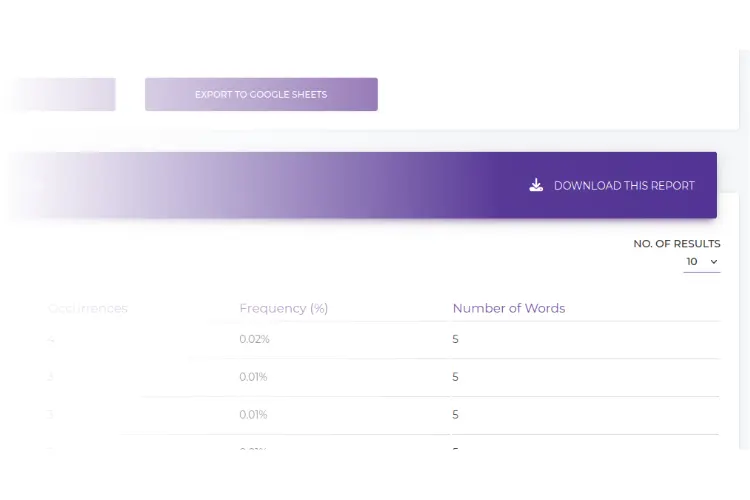
Once your analysis is complete, export your results instantly to Google Sheets with the dedicated export button located directly in the tool interface. This creates a new spreadsheet with your complete keyword density analysis, making it easy to:
- Share results with team members or clients
- Track optimization progress over time
- Compare multiple pages side-by-side
- Integrate density data into broader SEO reports
- Archive analysis for future reference
The one-click export feature streamlines your workflow, eliminating the need to manually record or screenshot your results.
You can also export the results in csv file.

Multi-Keyword Analysis
Analyze multiple target keywords simultaneously by entering each on a new line. The tool calculates density for all keywords in a single run, showing you at a glance how each term is represented.
Automated N-gram Generation
The tool automatically identifies all n-grams from 1-word to 5-word phrases, revealing natural language patterns and long-tail keyword opportunities beyond your specified target keywords.This means you'll see not just individual keyword occurrences, but also 2-word phrases, 3-word phrases, 4-word phrases, and 5-word phrases that appear throughout the content.
For example, analyzing a page about "email marketing" might reveal:
- 1-word: "email" (18 occurrences), "marketing" (22 occurrences)
- 2-word: "email marketing" (12 occurrences), "email campaigns" (8 occurrences)
- 3-word: "email marketing strategy" (5 occurrences), "successful email campaigns" (4 occurrences)
- 4-word: "email marketing best practices" (3 occurrences)
- 5-word: "how to create email marketing" (2 occurrences)
This comprehensive n-gram analysis helps you understand the natural language patterns in content and identify long-tail keyword opportunities that might be worth targeting more deliberately.

How To Use Our Keyword Density Analyzer
Getting started with the Creeper Keyword Density Checker is simple and intuitive. The tool is available right on this page, so you can begin analyzing immediately.Here are the two primary workflows you'll use depending on your analysis needs.
Workflow 1: Analyze a Live URL
This is the most common use case, checking keyword density on a published webpage, whether it's your own content you're optimizing or a competitor page you're researching.
- Step 1: Enter the URL: You don't even need to bother with pasting the content. Just input the URL of the webpage (include "https://") you want to analyze for free, whether you're performing keyword density analysis, analyzing meta keyword length, or other aspects of your SEO.
- Step 2: Add Your Target Keywords: Choose the keywords you want to evaluate for frequency and density using Creeper's free tool. In the keywords field, enter your target keywords. For multiple keywords, simply enter each one on a new line:
email marketing
email campaigns
email marketing strategy - Step 3: Select Your Language: Choose your preferred language from the checkbox options: English, Spanish, Slovenian, or Croatian. This ensures accurate stopword filtering for your content.
- Step 4: Click "Analyze": Hit the Analyze button and within seconds, you'll receive a comprehensive report with keyword frequency, keyword density percentages, occurrence counts, and automatically generated n-grams (1-5 word phrases).
- Step 5: Review and ExportReview your results to check if primary keyword density is between 1-2%, identify any keywords over 5-6% that may indicate over-optimization, and examine the n-gram analysis for natural phrase patterns. When you're ready, click the "Export to Google Sheets" button to save your complete analysis.

Workflow 2: Multi-Keyword + N-gram Analysis
When you're conducting comprehensive content analysis or competitive research, you'll want to track multiple keywords simultaneously and examine how various phrase lengths appear throughout the content.
For Comprehensive Content Analysis:
- Prepare your keyword list including primary, secondary, and related terms you want to track
This workflow is perfect for competitive research, comprehensive content audits, and tracking multiple keyword variations across your content.
Why Creeper Matters in SEO
Understanding why the Creeper Keyword Density Checker Tool matters requires seeing it in the context of modern SEO strategy. This isn't just about hitting target percentages—it's about creating content that serves users while strategically signaling relevance to search engines.
Optimize Content for Free
Creeper identifies both overused and underutilized keywords without subscription fees, democratizing SEO optimization for small businesses, independent creators, and startups.
Balance Keyword Usage
keyword density usage data guide content creators in optimizing for search engines while keeping the content engaging and informative. Replace repetition with semantic variations that provide topical signals without sounding robotic.
Ensure Relevancy and Consistency
Density analysis ensures your target topic receives consistent attention throughout long-form content, reinforcing topical authority and helping search engines confidently categorize your content.
Modern SEO Context Beyond Density
Modern search engines employ natural language processing to understand content like humans do. Google's BERT understands context, entity recognition identifies specific concepts, and semantic analysis recognizes that different words can refer to the same concept. Use the Creeper tool to ensure appropriate keyword usage, then focus on comprehensive topic coverage, natural language, and demonstrating expertise through content depth .This includes optimizing elements like the body tag for main content placement and avoiding outdated practices such as over-relying on keyword tags in meta sections.
Historical Context: Panda & Keyword Stuffing
In early search engines, websites could rank by repeating keywords hundreds of times. Google's 2011 Panda update targeted low-quality content including keyword stuffing, fundamentally changing SEO. Today's algorithms recognize natural language patterns and reward user experience over keyword targets. Current best practices emphasize moderate density (1-2%) and natural integration, avoiding the over-optimization that now carries significant risks. Historically, practices like web spam through excessive keyword repetition in meta tags or hidden text were common but are now penalized, making tools like a meta tag analyzer essential for compliance.
Content Quality vs. Keywords
Writing for humans matters more than writing for algorithms. Focus first on creating valuable content that answers questions and solves problems. Once you have quality content, use Creeper to ensure appropriate keyword signals without sacrificing readability. Search engines increasingly measure user engagement signals—if your content doesn't engage readers, negative signals will undermine optimization efforts.
Avoid Keyword Stuffing
Prevent unintentional over-optimization that harms user experience and can trigger algorithmic penalties. Catch and correct issues before publishing by rewriting sections with synonyms and restructured sentences.
Boost Rankings
Implement data-driven changes based on Creeper's insights, all within the framework of a free keyword density checker tool.
Frequently Asked Questions
Get answers to common questions about our Keyword Density tool.
What is keyword density?
Keyword density is the percentage of times a keyword appears compared to total words, calculated as: (Keyword occurrences / Total words) × 100. It helps indicate how prominently a topic is featured in your content.
What's the ideal keyword density?
There's no universal perfect density. General guidelines suggest:
- 1-2% for primary keywords – Clear topical signals without over-optimization
- 0.5-1.5% for long-tail phrases – Natural frequency for longer phrases
- Under 1% is typically under-optimized – May lack sufficient topical focus
- Above 5-6% is the warning zone– Risk of appearing stuffed
Most importantly, analyze the top 10 ranking pages for your target keyword using Creeper to identify what's actually working in your niche.
How do I fix keyword stuffing?
Replace repetitions with synonyms and semantic variations. Use pronouns and implied references instead of restating keywords. Restructure sentences for natural flow. Expand content with related subtopics to dilute concentration while adding value. After changes, re-analyze with Creeper to verify improved density.
Does keyword density affect ranking?
Keyword density is a minor factor in modern SEO. It helps search engines identify your topic and ensures relevance, but has far less impact than backlinks, domain authority, content comprehensiveness, user engagement metrics, and technical SEO factors like Core Web Vitals. Think of density as necessary but not sufficient for ranking success.
Can I analyze content drafts before publishing?
Currently, the Creeper Keyword Density Checker analyzes live URLs only. To check drafts, you'll need to publish them (perhaps on a staging site or private URL) before analysis. This workflow helps ensure your content is properly optimized before making it publicly available. For drafts, some users reverse the process by using temporary URLs or apps that simulate live pages.
How does density relate to keyword difficulty?
Keyword difficulty measures how hard it is to rank based on the authority and backlink profiles of currently ranking pages. High-difficulty keywords require strong backlinks and domain authority to rank, regardless of perfect density. Use density optimization alongside broader SEO efforts including link building and authority development. Analyzing link data can provide further statistics on competitors' strategies.
Recommended Keyword Density Guidelines
Target Ranges
- 1–2% for single-word or short-phrase primary keywords
- 0.5–1.5% for long-tail keyword phrases
- Under 1% indicates potential under-optimization
- 5–6%+ warning zone for potential over-optimization
Important Nuances
There is no exact ideal density that guarantees rankings. Context matters—competitive niches may show different patterns. Always benchmark against actual top-ranking pages in your SERP using Creeper's competitive analysis capabilities. Focus on natural writing that serves users first, then verify appropriate keyword signals with density checking. Monitor word usage to maintain optimal keyword density levels and avoid spam signals that could attract bots or robots from search engines.